
Small Modular Reactors
About
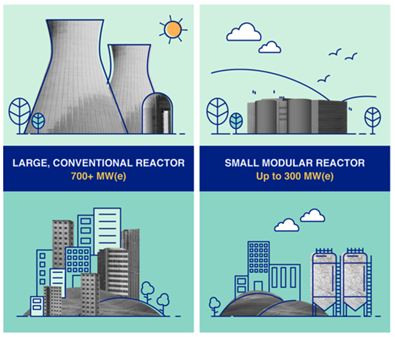
- Small modular reactors (SMRs) are small nuclear reactors with a maximum output of 300 Megawatt electric (MWe), which is about one-third of the generating capacity of traditional nuclear power reactors.
- They are:
- Small – physically a fraction of the size of a conventional nuclear power reactor.
- Modular – making it possible for systems and components to be factory-assembled and transported as a unit to a location for installation.
- Reactors – harnessing nuclear fission to generate heat to produce energy.
- They all use nuclear fission reactions to generate heat that can be used directly or for generating electricity.
Advantages of SMRs
- SMRs are designed with a smaller core damage frequency (the likelihood that an accident will damage the nuclear fuel) and source term (a measure of radioactive contamination) compared to conventional Nuclear Power Plants (NPPs).
- SMR designs are also simpler than those of conventional NPPs and include several passive safety features, resulting in a lower potential for the uncontrolled release of radioactive materials into the environment.
- As they are smaller in size, power output and capacity, they need less space and less cooling water, offering greater flexibility for site selection than large nuclear plants.
- Most land-based SMR designs require low-enriched uranium, which can be supplied by all countries that possess uranium mines.
- They are modular and can be produced in series, which allows for production cost efficiency through economies of scale.
Global Status
- Globally, there are more than 80 SMR designs at different stages of development across 18 countries.
- While countries such as the U.S., UK, Canada, Japan, and South Korea are actively developing their own designs, Russia and China connected their first SMRs to the grid in 2019 and 2021, respectively.
Status in India
- In the Union Budget 2025-2026, the Government announced that a Nuclear Energy Mission for research & development of Small Modular Reactors (SMR) will be set up and at least 5 indigenously developed SMRs will be operationalized by 2033.