International Criminal Court
About
- The International Criminal Court (ICC) is a permanent international court established in 2002 following the adoption of the Rome Statute (1998).
- It is an independent judicial body distinct from the UN.
- The ICC was established as a court of last resort to prosecute the most heinous offenses in cases where national courts fail to act.
- Unlike the International Court of Justice (ICJ), which hears disputes between states, the ICC handles prosecutions of individuals.
- ICC investigates and tries individuals charged with the gravest crimes of concern to the international community: genocide, war crimes, crimes against humanity and the crime of aggression.
- Refer SCA Prelims Magazine December Edition for details about ICJ.
- ICC investigates and tries individuals charged with the gravest crimes of concern to the international community: genocide, war crimes, crimes against humanity and the crime of aggression.
- ICC is headquartered in The Hague, Netherlands.
About
- The Court may exercise jurisdiction in a situation where genocide, crimes against humanity or war crimes were committed on or after 1 July 2002 (when Rome Statute entered into force) and:
- the crimes were committed by a State Party national, or in the territory of a State Party, or in a State that has accepted the jurisdiction of the Court; or
- the crimes were referred to the ICC Prosecutor by the United Nations Security Council (UNSC).
Membership:
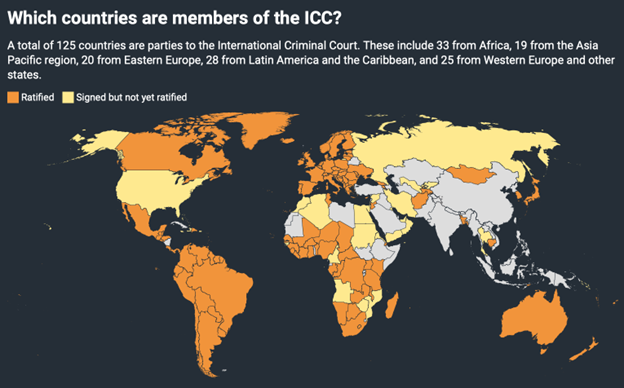
- Only those who ratified (125 countries) the Rome Statute are parties to ICC.
- Prominent countries that are not members include the United States, Russia, China, India, Israel, Turkey, Pakistan, etc.