
Sixteenth Finance Commission
Finance Commission
- The Finance Commission is a constitutional body set up under Article 280 of the Constitution.
- Under Article 280, the President of India is required to constitute a Finance Commission at an interval of five years or earlier.
Did you know?
- The First Finance Commission was constituted in 1952 under the chairmanship of K.C. Neogy.
Qualifications:
- The Finance Commission consists of a chairman and four members appointed by the President.
- As per the Finance Commission [Miscellaneous Provisions] Act, 1951 and The Finance Commission (Salaries & Allowances) Rules, 1951, the Chairman of the Commission is selected from among persons who have had experience in public affairs, and the four other members are selected from among persons who:
- are, or have been, or are qualified to be appointed as Judges of a High Court; or
- have special knowledge of the finances and accounts of Government; or
- have had wide experience in financial matters and in administration; or
- have special knowledge of economics.
Functions:
- The Finance Commission shall make recommendations to the President as to the following matters:
- the distribution of tax proceeds between the Union and the States and the share of each state.
- the principles which should govern the grants-in-aid of the revenues of the States out of the Consolidated Fund of India;
- the measures needed to augment the Consolidated Fund of a State to supplement the resources of the Panchayats in the State on the basis of the recommendations made by the Finance Commission of the State;
- the measures needed to augment the Consolidated Fund of a State to supplement the resources of the Municipalities in the State on the basis of the recommendations made by the Finance Commission of the State;
- any other matter referred to the Commission by the President in the interests of sound finance.
- The recommendations made by the Finance Commission are advisory in nature and not binding on the government.
Why in News?
- Finance Minister Nirmala Sitharaman laid the 16th Finance Commission report for the period 2026-2031 in the Lok Sabha.
- The 16th Finance Commission was constituted by the President in 2023 under the chairmanship of Dr. Arvind Panagariya, former Vice- chairman of NITI Aayog.
- The Commission was mandated to make its recommendations for the five‑year period commencing on 1 April 2026 and ending on 31 March 2031.
Key Recommendations
Vertical & Horizontal Devolution:
- The 16th FC has recommended that the Central Government retain the 41% share of tax devolution to the States (vertical devolution) that had been implemented since 2021.
- The change in the states’ share (horizontal devolution) is due to a change in formula adopted by the 16th FC, based on six criteria, including some new ones:
- Per capita Gross State Domestic Product (GSDP) distance (42.5 per cent weight),
- Population (17.5 per cent),
- Demographic performance (10 per cent),
- Area (10 per cent),
- Forest (10 per cent), and
- Contributions to GDP (10 per cent).
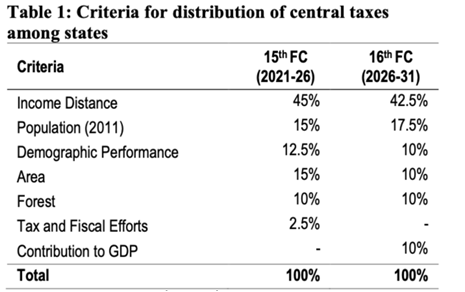
- Per Capita GSDP Distance (Income Distance): It is the difference between the per capita GSDP of a state and the average of the per capita GSDP of the top three large states with the highest per capita GSDP. States with a lower per capita GSDP will receive a higher share on this parameter, to maintain equity among states.
- Population: On this parameter, the share in devolution is determined based on the share in the population as per the 2011 Census.
- Demographic Performance: The 15th FC had introduced this parameter to award states for controlling population. The 16th FC has redefined this to account for population growth between 1971 and 2011. States with lower population growth will have a higher share under this parameter.
- Forest: The 16th FC has assigned weightage to both the share of a state in the overall forest area, and its share in the increase in overall forest area between 2015 and 2023. Further, it has also considered open forests in arriving at the total forest area. In contrast, the 15th FC had considered only dense and moderately dense forests, and defined the parameter only in terms of share in the overall forest area.
- Contribution to GDP: The 16th FC has introduced this parameter to account for the contribution to national GDP. This replaces the tax and fiscal efforts parameter used by the 15th FC which rewarded states with a higher tax collection efficiency.
Grants-in-Aid:
- In a major departure from earlier Finance Commissions, the panel has recommended no revenue deficit grants (RDGs), arguing that states have significant scope to increase revenues and rationalise expenditure.
- RDGs were designed to fill the gap between what a state earns and what it must spend to run essential public services.
- In addition, the Commission does not recommend any sector-specific or State-specific grants but has earmarked Rs. 7.91 trillion for rural and urban local bodies over 2026-31, with a 60:40 rural-urban split, and a strong emphasis on water, sanitation, and urban infrastructure.
- Special Infrastructure Grants (tied to the development of a comprehensive wastewater management system in cities) and Urbanisation Premium Grants (one-time grant for merger of peri-urban villages into adjoining urban local body areas and formulation of a Rural to Urban Transition Policy) have also been recommended for urban local bodies.
- It also recommended Rs. 2.04 trillion for State disaster response and mitigation funds plus about Rs. 79,000 crore for national funds, allocated using a revamped disaster risk index.
Other Recommendations:
- The Commission has also recommended capping states’ fiscal deficits at 3 per cent of GSDP (excluding loans under SASCI) and lowering the Union government’s fiscal deficit to 3.5 per cent of GDP by 2030-31.
- Under the Scheme for Special Assistance to States for Capital Investment (SASCI), the Centre provides 50‑year interest‑free loans to states exclusively for capital expenditure.
- It has also called for the complete discontinuation of off-budget borrowings by states, with all such liabilities brought onto budget, and for state fiscal responsibility laws to be amended to ensure uniformity and alignment with the Commission’s consolidation roadmap.
- Off-budget borrowing refers to a government’s practice of raising funds for various purposes without reflecting these expenditures in the official budget.
- Considering the concerns over “fiscal populism”, the Commission has recommended the rationalisation of subsidy schemes and the introduction of “sunset clauses” for schemes that give subsidies on non-merit private goods and unconditional transfers.
- A sunset clause is a provision that sets a mandatory expiry date for a program, forcing its evaluation and renewal to continue.
- The Commission recommended a review and closure of 308 inactive State Public Sector Enterprises (SPSEs).
- The Commission has also recommended privatising the country’s power distribution sector as a crucial step to modernise it and address its long-standing financial stress.