Revised Consumer Price Index
About
- The Consumer Price Index (CPI) is designed to measure the changes over time in the general level of retail prices of selected goods and services that households purchase for the purpose of consumption.
Significance
- The Reserve Bank of India and other statistical agencies study CPI so as to understand the price change of various commodities and keep a tab on inflation.
- Under the Flexible Inflation Targeting (FIT) framework, the RBI targets to contain CPI based inflation within 4 percent with a tolerance band of (+/-) 2 percent.
- CPI is also a helpful pointer in understanding the real value of wages, salaries and pensions, the purchasing power of a country’s currency, and regulating prices.
Types of CPI
- The National Statistical Office (NSO), Ministry of Statistics and Programme Implementation releases
- CPI for Rural
- CPI for Urban and
- CPI Combined (computed by combining CPI Rural and CPI Urban).
- In addition to these, different types of CPI numbers are released by the government which includes:
- CPI for Industrial Workers (IW) [Base year: 2016]
- CPI for Agricultural Labourers (AL) [Base year: 2019]
- CPI for Rural Labourers (RL) [Base year: 2019].
- The Ministry of Labour & Employment collects the data for CPI (IW), CPI (AL) and CPI (RL) and compiles it.
CPI Revision
- The Ministry of Statistics and Programme Implementation (MoSPI) has introduced a new CPI series with an updated base year of 2024 (from the earlier 2012), wider coverage of goods and services, and new weights given to goods and services based on consumption patterns revealed in the latest Household Consumption Expenditure Survey (HCES) 2023-24.
Household Consumption Expenditure Survey:
- HCES is conducted by the MoSPI to collect information on consumption and expenditure of the households on goods and services.
- The survey provides data required to assess trends in economic well-being and to determine and update the basket of consumer goods and services and weights used for the calculation of the Consumer Price Index.
- Data collected in HCES is also used to measure poverty, inequality, and social exclusion.
- The total number of items covered under the new series has increased to 358 from the 299 items in the older series. Of these, the number of goods covered has increased to 308 from 259, and the number of services included has gone up to 50 from the earlier 40.
- The new series also collects data from more sources across the country.
- Data is collected from 1,465 rural markets, up from 1,181. The number of urban markets covered has gone up to 1,395 from 1,114. Notably, the new series also collects data from 12 online marketplaces, a new category that has been included now.
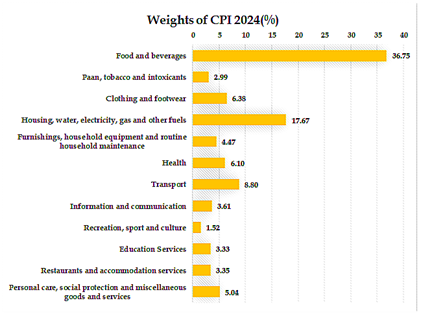
- The new series provides more granular data by dividing the underlying goods and services into 12 broad groups compared to the six groups under the older series.
- The weightage assigned to the food and beverages category has been revised downward in the new series to 36.75% from the earlier 45.86%.
- The housing category, with an earlier weight of 10.07%, has been expanded to also include water, electricity, gas and other fuels, and this combined category now has a weight of 17.67% in the new series.
- The additional groups in the new series include furnishings, household equipment and routine household maintenance (with a weight of 4.47%), health (6.1%), transport (8.8%), information and communication (3.61%), recreation, sports and culture (1.52%), education services (3.33%), restaurants and accommodation services (3.35%), and personal care, social protection and miscellaneous goods and services (5.04%).
- The paan, tobacco and intoxicants category saw its weight increase to 2.99% from 2.38% in the older series. The clothing and footwear category’s weight fell to 6.38% from 6.53%.