
Ports in India
About
- Ports in India handle around 95% of EXIM Cargo by volume and 70% by value.
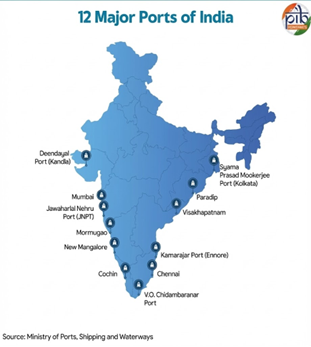
- The country hosts 12 major ports and 200+ non-major (minor) ports across its coastline.
- The major ports (governed by the Major Port Authorities Act, 2021) are wholly-owned by the Government of India and operate under the administrative purview of the Ministry of Ports, Shipping and Waterways, while non-major ports fall under the jurisdiction of respective States.
- Major ports are: Deendayal Port (Gujarat), Mumbai & Jawaharlal Nehru Port (Maharashtra), Mormugao Port (Goa), New Mangalore Port (Karnataka), Cochin Port (Kerala), V.O Chidambaranar, Kamarajar & Chennai Port (Tamilnadu), Vishakapatnam Port (Andhra Pradesh), Paradip Port (Odisha), and Syama Prasad Mookerjee Port (West Bengal).
- In 2024, the Union Cabinet approved the setting up of a Major Port at Vadhavan, Maharashtra.
- Public-Private Partnership (PPP) participation is allowed through a concession agreement for specific projects, berths, or terminals within these major ports.
- This participation is secured via an open competitive bidding process, where the concessionaire pays revenue share or royalty for a fixed period. Once the concession period concludes, the port assets are returned to the port authority.
- All Major Ports except Kamrajar are administered by the respective Port Trusts, which are autonomus bodies.
- Kamarajar Port (formerly Ennore Port) is the only corporatised major port and is registered as a company.
Vizhinjam International Deepwater Multipurpose Seaport:
- The Vizhinjam International Deepwater Multipurpose Seaport in Kerala, inaugurated in May 2025, marks a strategic shift towards reducing reliance on foreign ports like Colombo, Singapore, and Dubai for container handling.
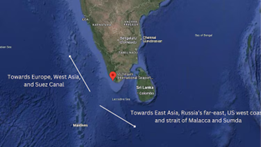
- As India’s first dedicated container transshipment port, Vizhinjam leverages its natural draft of about 20 metres, requiring minimal capital dredging, and its proximity (just 10 nautical miles) to international shipping routes linking Europe, West Asia and the Far East — the east-west shipping axis.
- A transshipment port is a hub where cargo is unloaded from one ship and reloaded onto another to continue its journey to a final destination, acting as a crucial transfer point for global trade when direct routes are unavailable or inefficient.
- It is also India’s first semi-automated port equipped with remote-controlled quay cranes and an AI-powered vessel traffic management system.
- The port was developed under a public-private partnership model spearheaded by the Kerala government with Adani Ports and Special Economic Zone Ltd (APSEZ) as the private partner.