
India Modernises Core Economic Data Systems
What’s in the news?
- The Ministry of Statistics and Programme Implementation (MoSPI) is undertaking a major overhaul of its national statistical system to ensure that official economic data keeps pace with the country’s rapidly changing economic structure.
Major Changes
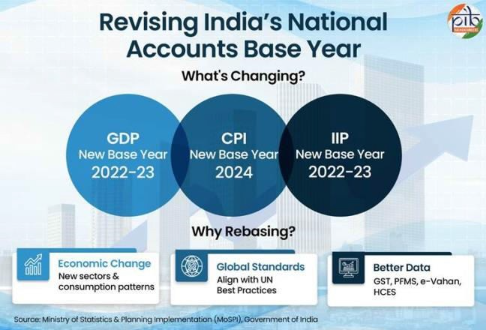
- A central feature of this effort is the revision of the base year for Gross Domestic Product (GDP) from 2011–12 to 2022–23.
- Rebasing allows national income estimates to better capture current production patterns, consumption behaviour and price structures. The year 2022–23 was selected as it represents a stable, post-pandemic period.
- The base year functions as the standard reference point, which enables economists to measure real economic growth by eliminating inflationary effects to determine actual output changes.
- The base year is updated from time to time to reflect the changes that have happened in the economy over the years. This helps make economic data more accurate.
- While the overall framework of GDP estimation remains unchanged, new data sources — including GST filings, e-Vahan vehicle registration data and the Public Financial Management System (PFMS) — are being integrated to improve accuracy and detail.
E-Vahan Portal:
- The E-Vahan Portal is an online platform that provides a range of services related to vehicle registration, driving licenses, and permits.
- The portal was launched in 2016 by the Ministry of Road Transport and Highways (MoRTH) and the National Informatics Centre (NIC).
Public Financial Management System:
- PFMS is a web-based online software application developed and implemented by the Controller General of Accounts (CGA), Department of Expenditure, Ministry of Finance.
- PFMS started during 2009 with the objective of tracking funds released under all Plan schemes of Government of India, and real time reporting of expenditure at all levels of Programme implementation.
- Subsequently, the scope was enlarged to cover direct payment to beneficiaries under all Schemes.
- The primary function of PFMS today is to facilitate sound Public Financial Management System for Government of India by establishing an efficient fund flow system as well as a payment cum accounting network.
- Similarly, the base year for the Consumer Price Index (CPI) is being updated to 2024.
- The Index of Industrial Production (IIP), which tracks changes in industrial output, is also being rebased to 2022–23.
- The updated series will incorporate revised product baskets, new weights and improved coverage of industries to reflect technological and structural changes.
- Earlier, the household sector was estimated using growth rates between surveys or proxy indicators. In the new series, actual level estimates are being prepared using regular annual surveys such as Annual Survey of Unincorporated Sector Enterprise (ASUSE) and Periodic Labour Force Survey (PLFS).
Double Deflation Methodology
- The new GDP series also introduces the “double deflation” method for key sectors like manufacturing and agriculture and complete elimination of single deflation method.
- Under this approach, the value of output and the cost of inputs are adjusted separately for price changes before calculating real growth.
- GDP aims to measure how much the economy is producing in “real” terms, that is, after removing the impact of inflation. To do this, statisticians use price indices (deflators).
- Under the earlier approach, GDP estimates often relied on single deflation, where output was adjusted using a single price index. The double deflation method will correct this by separately adjusting output and input prices to make GDP estimates more robust and internationally aligned.
International Statistical Standards
- India prepares its GDP estimates according to the 2008 System of National of Accounts (SNA 2008), which is a globally accepted standard.
- Besides, India is also a subscriber of IMF’s Special Data Dissemination Standard (SDDS), which indicates that the country meets all the tests of good statistical citizenship.
- The revised series is in sync with the international statistical standards.