
Zonal Councils
About
- Zonal Councils are statutory bodies set up under the States Re-organization Act, 1956 to provide a common meeting ground to the States and UTs for resolution of inter-state and regional issues and building harmonious Centre-State relations.
Did you know?
- The idea of creation of Zonal Councils was mooted by the first Prime Minister of India, Pandit Jawahar Lal Nehru in 1956.
Composition
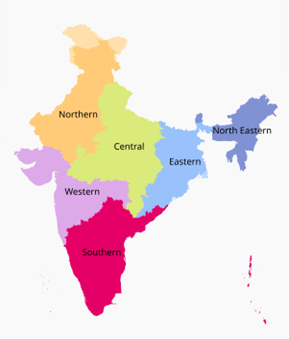
- The States Re-organisation Act established five Zonal Councils namely:
- Northern Zonal Council, comprising States/UTs of Himachal Pradesh, Haryana, Punjab, Rajasthan, Delhi, Chandigarh, Jammu and Kashmir and Ladakh;
- Central Zonal Council, comprising Chhattisgarh, Uttarakhand, Uttar Pradesh and Madhya Pradesh;
- Eastern Zonal Council, comprising Bihar, Jharkhand, Orissa, and West Bengal;
- Western Zonal Council, comprising Goa, Gujarat, Maharashtra and the UT of Dadra and Nagar Haveli and Daman and Diu;
- Southern Zonal Council, comprising Andhra Pradesh, Telangana, Karnataka, Kerala, Tamil Nadu and the UT of Puducherry.
- The North Eastern States i.e. (i) Assam (ii) Arunachal Pradesh (iii) Manipur (iv) Tripura (v) Mizoram (vi) Meghalaya and (vii) Nagaland are not included in the Zonal Councils and their special problems are looked after by the North Eastern Council, set up under the North Eastern Council Act, 1972.
- The State of Sikkim has also been included in the North Eastern Council from 2002.
Structure
- Chairman: Union Home Minister.
- Vice Chairman: Chief Ministers of the States included in each zone by rotation (each holding office for a period of one year at a time).
- Members: Chief Minister and two other Ministers as nominated by the Governor from each of the States and two members from Union Territories included in the zone.
- Union Ministers are also invited to participate in the meetings of Zonal Councils depending upon necessity.
- Each Zonal Council has set up a Standing Committee consisting of Chief Secretaries of the member States of their respective Zonal Councils.
- These Standing Committees meet from time to time to resolve the issues or to do necessary ground work for further meetings of the Zonal Councils.
- Each Council is an advisory body providing a structured forum for dialogue on inter-state and centre-state issues, acting as a key platform to foster mutual cooperation.