
Reforms to Expand Foreign Participation in G-Secs
What’s in the news?
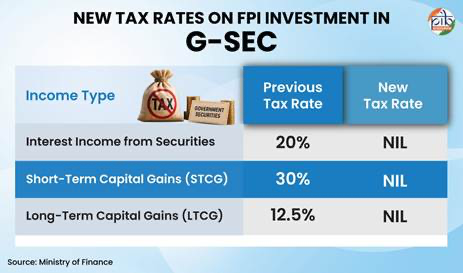
- With an aim to attract foreign capital, the government has promulgated the Income Tax Amendment Ordinance, 2026 to grant a full tax exemption on income earned from government securities by Foreign Institutional Investors (FIIs).
- The relief covers both interest income and capital gains arising from such investments.
- The same relief has also been extended to the Bank of International Settlements (BIS). As a result, any interest income or capital gains generated by the BIS from transactions involving government securities will qualify for exemption.
Foreign Portfolio Investment (FPI):
- FPI refers to investments made by foreign individuals, institutional investors, or funds in financial instruments such as stocks, bonds, mutual funds, and government securities.
- FPIs do not participate in the management or decision-making of the companies in which they invest and are generally considered passive investors.
Foreign Institutional Investment (FII):
- FII is a category of FPI that refers specifically to investments made by foreign institutional investors such as mutual funds, pension funds, insurance companies, and hedge funds.
- These institutions invest pooled funds in financial markets and typically play a more active role in investment research and decision-making.
Government Securities (G-Secs):
- G-Sec is a tradable instrument issued by the Central Government or the State Governments. It acknowledges the Government’s debt obligation.
- Such securities are short term (usually called treasury bills, with original maturities of less than one year) or long term (usually called Government bonds or dated securities with original maturity of one year or more).
- In India, the Central Government issues both, treasury bills and bonds or dated securities while the State Governments issue only bonds or dated securities, which are called the State Development Loans (SDLs).
- G-Secs carry practically no risk of default and, hence, are called risk-free gilt-edged instruments.
- Foreign Portfolio Investors (FPIs) are allowed to participate in the G-Secs market in India within the quantitative limits prescribed from time to time (currently 6% of outstanding stocks of securities).
Bank for International Settlements (BIS):
- BIS is an international financial institution owned by central banks.
- It serves as a forum for monetary and financial cooperation among central banks globally.
- It also acts as a banker and asset manager for central banks and international organizations.
- At present, FIIs pay 12.5% tax on long-term capital gains, 30% on short-term capital gains, and around 20% tax on interest income.
Classification of Capital Gains:
- Capital gains refer to the profits earned from the sale of capital assets, such as real estate, stocks, mutual funds, and other investments. Capital gains tax is the tax levied on these gains.
- Long-Term Capital Gains (LTCG) arise when a Government Security is held beyond the prescribed holding period:
- Listed G-Secs: More than 12 months.
- Unlisted G-Secs: More than 24 months.
- Short-Term Capital Gains (STCG) arise when a Government Security is held for less than the prescribed holding period:
- Listed G-Secs: Up to 12 months.
- Unlisted G-Secs: Up to 24 months.
- The move is aimed at making Indian debt markets more attractive to overseas investors.
- Further, the government also announced that 15, 30, and 40-year tenor bonds will be added to investment under Fully Accessible Route (FAR) framework.
- Foreign investors can invest in Indian G-Secs through routes such as the General Route and the Fully Accessible Route (FAR).
- General Route is the standard channel for foreign investors. It allows them to buy and sell permitted Indian G-secs, but comes with certain restrictions, such as caps on how much can be invested in a particular security, how long it must be held, and an overall investment limit.
- FAR is an open-access channel where foreign investors can invest in select G-Secs without restrictions that apply under the General Route.
- As of May 2026, FPIs held G-Secs worth ₹3,75,171 crore, accounting for 3.34% of the total outstanding G-Secs stock of ₹112.42 lakh crore. Notably, FAR accounted for the majority of these investments, with FPI holdings of ₹3.21 lakh crore, representing 6.74% of the ₹47.63 lakh crore outstanding stock eligible under FAR.
- Caps on short-term investment, concentration and security-wise limits on FPI investment through the general route have also been removed while keeping the overall quantitative investment limit of 6% of the outstanding stock of the Central Government Securities and 2% of the State Government Securities (SGSs).