
India-Oman CEPA
What’s in the news?
- The India-Oman Comprehensive Economic Partnership Agreement (CEPA) signed in 2025 has entered into force.
Key Provisions of CEPA
- Under CEPA, Oman has offered zero-duty access on 98% of its tariff lines, covering 99% of India’s exports to Oman.
- India is offering tariff liberalization on 78% of its total tariff lines which covers 95% of India’s imports from Oman by value.
- To safeguard its interest, sensitive products have been kept in the exclusion category by India without offering any concessions, especially agricultural products, gold and silver bullion, jewellery, and other labour-intensive products.
- The deal also includes several concessions that are expected to benefit India’s service sector.
- A key highlight is enhanced mobility for Indian professionals. For the first time, Oman has offered wide-ranging commitments under Mode 4 (movement of skilled professionals).
Modes of supply of services:
- International trade in services typically occurs in any of these four modes of supply:
- Cross border trade (Mode 1): It is the supply of a service from the territory of one country into the territory of another country.
- Consumption abroad (Mode 2): It is the supply of a service in the territory of one country to the consumer of another country.
- Commercial presence (Mode 3): It is the supply of a service by a service supplier of one country, through commercial presence, in the territory of another country.
- Presence of natural persons (Mode 4): It is the supply of a service by a service supplier of one country, through the presence of natural persons of a country in the territory of another country.
- The CEPA further provides for 100 per cent Foreign Direct Investment (FDI) by Indian companies in major services sectors in Oman through commercial presence, opening a wide avenue for India’s services industry.
- The agreement will also promote cooperation in AYUSH, wellness, healthcare, and medical tourism.
Oman:
- Oman is located on the southeastern edge of the Arabian Peninsula, bordering the Arabian Sea and the Gulf of Oman.
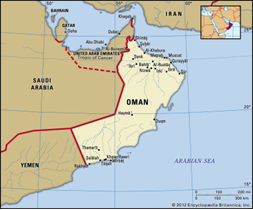
- It borders the Strait of Hormuz and the Persian Gulf. Oman shares land borders with Saudi Arabia, the United Arab Emirates, and Yemen, and it shares maritime borders with Iran and Pakistan.
- Capital: Muscat.
Why does the pact matter?
- Oman is India’s second-largest trading partner in the Gulf region and is a key gateway for Indian goods and services to the wider Middle East and Africa.
- India–Oman bilateral trade stood at about $11.18 billion in 2025–26, with India running a trade deficit largely due to energy and fertilizer imports.
- Nearly 7 lakh Indian nationals live in Oman, and India receives around $2 billion in remittances annually from the country.
- This is India’s second CEPA with a Gulf Cooperation Council (GCC) member after the United Arab Emirates (UAE) agreement implemented in 2022.
Gulf Cooperation Council:
- GCC is a regional, intergovernmental, political, and economic union comprising Bahrain, Kuwait, Oman, Qatar, Saudi Arabia, and the United Arab Emirates.
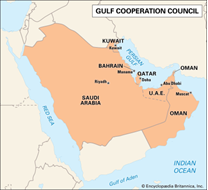
- GCC was established in 1981 in Riyadh, Saudi Arabia in view of their special relations, geographic proximity, similar political systems based on Islamic beliefs, joint destiny and common objectives.
- The official language is Arabic. The Secretariat is located in Riyadh.
- For Oman, this is its first bilateral trade agreement since signing one with the US in 2006.