
PM SHRI Schools
About
- PM SHRI School (PM ScHools for Rising India) is a centrally sponsored scheme launched by the Government of India in 2022.
- This initiative aims to upgrade and develop more than 14500 Schools across the country by strengthening the selected existing schools from amongst schools managed by Central Government/ State/ UT Government/ local bodies.
- The scheme aims to transform selected schools into model institutions showcasing all components of the National Education Policy 2020.
- These schools will focus on quality education, holistic development and 21st-century skills, while also serving as mentor institutions for neighboring schools.
National Education Policy 2020:
- The National Education Policy (NEP) 2020 was announced to transform the education system in the country and to replace the 34-year-old National Policy on Education (NPE), 1986.
- NEP 2020 is founded on the five guiding pillars of Access, Equity, Quality, Affordability and Accountability.
Highlights of the Policy:
1. Early Childhood Care & Education:
- The policy places early learning at the heart of school reform, recognising that over 85% of brain development happens before age six.
- It replaces the current 10+2 structure in school education with a new 5+3+3+4 structure corresponding to ages 3-8, 8-11, 11-14, and 14-18 years respectively.
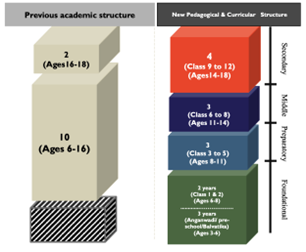
- The new system will have 12 years of schooling with three years of Anganwadi/ pre-schooling.
2. School Education:
- The policy aims to achieve 100% Gross Enrolment Ratio (GER) in preschool to secondary level by 2030.
- There will be no rigid separations between arts and sciences, between curricular and extra-curricular activities, between vocational and academic streams.
- Vocational education will start in schools from the 6th grade, and will include internships.
- A National Mission on Foundational Literacy and Numeracy will be set-up to focus on early language and mathematical skills from Grades 1 to 3 by 2025.
- The medium of instruction until at least class 5 (and preferably till class 8) should be home language or mother tongue or local/regional language.
- The policy gives the freedom to the state, region, and child to choose three languages to be learned.
3. Higher Education:
- The policy aims to increase GER in higher education from 26.3% (2018) to 50% by 2035.
- By 2040, all higher education institutions (HEIs) shall aim to become multidisciplinary institutions, each of which will aim to have 3,000 or more students.
- There shall, by 2030, be at least one large multidisciplinary institution in or near every district.
- Affiliation of colleges is to be phased out in 15 years and a stage-wise mechanism is to be established for granting graded autonomy to colleges.
- Higher Education Commission of India (HECI) will be set up as a single umbrella body for the entire higher education, excluding medical and legal education.
- Internationalization of education will be facilitated through both institutional collaborations, and student and faculty mobility and allowing entry of top world ranked Universities to open campuses in our country.
- A new entity – National Research Foundation (NRF) – will be set up to catalyze and expand research and innovation across the country.
- A National Mission for Mentoring will be established, with a large pool of outstanding senior/retired faculty, to provide mentoring/professional support to university/college teachers.
4. Others Focus Areas:
- An autonomous body, the National Educational Technology Forum (NETF), will be created to provide a platform for the free exchange of ideas on the use of technology for school and higher education.
- NEP 2020 emphasizes setting up of Gender Inclusion Fund, Special Education Zones for disadvantaged regions and groups.
- A new National Assessment Centre, PARAKH (Performance Assessment, Review, and Analysis of Knowledge for Holistic Development), will be set up as a standard-setting body for all recognized school boards of India.
- National Institute for Pali, Persian and Prakrit and Indian Institute of Translation and Interpretation (IITI) to be set up.
- By 2025, at least 50% of learners through the school and higher education system shall have exposure to vocational education.
- The policy also aims to achieve 100% youth and adult literacy.
- The Centre and the States will work together to increase the public investment in the Education sector to reach 6% of GDP at the earliest.