
India–Middle East–Europe Economic Corridor
About
- The India-Middle East-Europe Economic Corridor (IMEC) is a multinational infrastructure project that aims to revolutionize global trade and connectivity.
- Launched at the 2023 G20 Summit in New Delhi, IMEC links India, the Middle East, and Europe through a multi-modal network of railways, ports, and highways.
- IMEC forms part of the Partnership for Global Infrastructure and Investment (PGII), a G7 collaborative initiative designed to fund infrastructure projects in developing nations.
Objectives
- IMEC is a transcontinental economic corridor designed to:
- Facilitate seamless trade and logistics between Asia, the Gulf, and Europe;
- Improve transportation infrastructure across key strategic regions;
- Foster economic cooperation and green development through sustainable infrastructure projects.
- This strategic corridor spans India, UAE, Saudi Arabia, Jordan, Israel, and Europe.
- IMEC is often viewed as a potential counterweight to China’s Belt and Road Initiative (BRI).
Belt and Road Initiative:
- The Belt and Road Initiative is a massive China-led infrastructure project that aims to stretch around the globe.
- Launched in 2013, the plan was two-pronged: the overland Silk Road Economic Belt and the Maritime Silk Road.
- The project initially aimed to strengthen connectivity with Southeast Asia but later expanded to South and Central Asia, Africa, Europe, and Latin America.
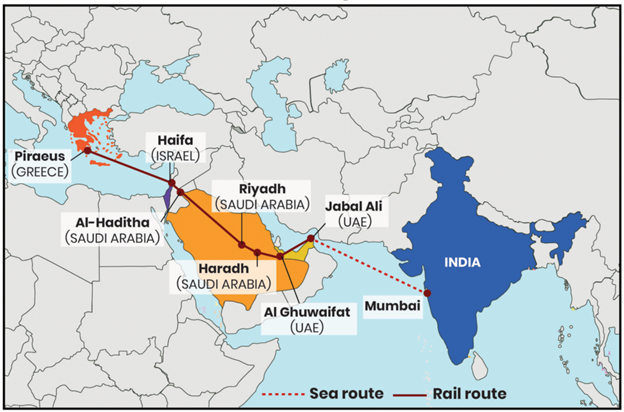
Participating Nations
- India, European Union, France, Germany, Italy, Saudi Arabia, UAE and the US have signed the Memorandum of Understanding (MoU) for IMEC.
Why in News?
- India and Italy agreed to further develop the India-Middle East-Europe Economic Corridor (IMEC) to strengthen trade, investment and supply-chain resilience.