
Strategic Crude Oil Reserves
About
- Strategic Petroleum Reserves (SPRs) are dedicated storage facilities developed to hold crude oil for emergency use.
- They act as a protective buffer, shielding the energy supply chain from short-term disruptions caused by external factors such as transportation delays, natural events, or fluctuations in global markets.
- India, the world’s third-largest consumer of crude, depends on imports for more than 85% of its requirement. SPR could help ensure energy security and availability during global supply shocks and other emergencies.
Status in India
- India’s SPR network is managed by the Indian Strategic Petroleum Reserves Limited (ISPRL), a Special Purpose Vehicle operating under the Ministry of Petroleum and Natural Gas.
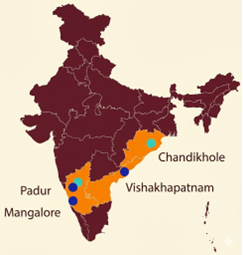
- Currently, India maintains SPR facilities at underground rock caverns at three places – Visakhapatnam (Andhra Pradesh), Mangalore (Karnataka) and Padur (Karnataka) – with a combined capacity to store 5.33 MMT (million metric tons) of crude oil, enough to provide 9.5 days of consumption.
- With this, the total national capacity for storage of crude oil and petroleum products is about 74 days, which includes 64.5 days of storage capacity maintained by Oil Marketing Companies (OMCs).
- The second phase of development is underway, which includes new storage locations such as Chandikhol (Odisha) and the expansion of the Padur facility, on a Public Private Partnership mode.
International Guideline
- The International Energy Agency (IEA) mandates that its member countries maintain SPRs equivalent to at least 90 days of their net oil imports to ensure energy security during supply disruptions.
International Energy Agency:
- IEA is an intergovernmental organization established in 1974 within the framework of the Organisation for Economic Co-operation and Development (OECD), in response to the 1973 oil crisis.
- IEA is dedicated to maintaining a steady supply of oil throughout the world.
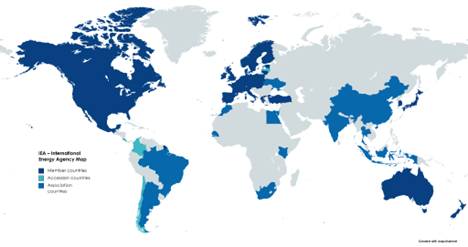
- The IEA is made up of 32 member countries.
- Before becoming a member country of the IEA, a candidate country must meet several criteria. These are:
- It must have crude oil or product reserves equivalent to 90 days of the previous year’s net imports.
- It must have in place a demand restraint program to reduce national oil consumption by up to 10 per cent.
- Legislation and measures to ensure that all oil companies under its jurisdiction report information upon request.
- Currently, India is an Associate Member of the agency and is yet to get a full membership.
- IEA is headquartered in Paris, France.