
INTERPOL
About
- International Criminal Police Organization (INTERPOL) is the world’s largest international police organization, with 196 member countries (including India).
- Created in 1923, it facilitates cross-border police cooperation and supports and assists organizations, authorities and services whose mission is to prevent or combat international crime.
- It is not a police force in the traditional sense—its agents are not able to arrest criminals. Instead, it is more of an information-sharing network, providing a way for national police forces to co-operate effectively and tackle international crime ranging from human trafficking and terrorism to money laundering and illegal art dealing.
- The General Assembly is INTERPOL’s supreme governing body. It meets annually for all important decisions such as finances, resources, and policy.
- The organization is based in Lyon, France and operates centralized criminal databases that contain fingerprint records, DNA samples and stolen documents.
INTERPOL’s Color-coded Notices
- INTERPOL uses a system of colour-coded notices as international alerts. These notices let police forces share critical crime-related information.
- Notices are issued by the General Secretariat at the request of a member country’s INTERPOL National Central Bureau.
- Central Bureau of Investigation (CBI), is the National Central Bureau for Interpol in India, which coordinates with all law enforcement agencies in India for assistance via INTERPOL channels.
Types of Notices
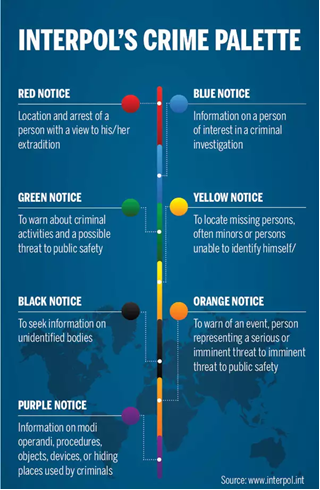
- The best-known of these is the “Red Notice”, a notification that a member state would like someone arrested.
- A special category of notices known as the “INTERPOL — United Nations Security Council Special Notice” is issued for entities and individuals who are the targets of UN Security Council Sanctions Committees.